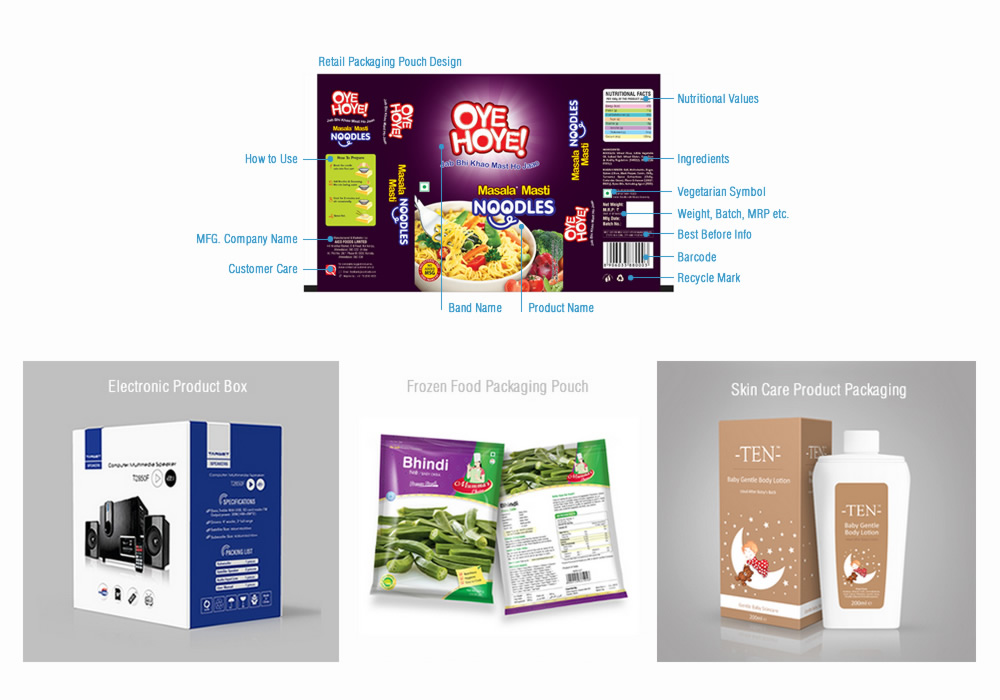
In our day-to-day lives, we see many products with good packaging design. Out of them, some attract us and some do not. Did you know why some product packaging gains consumers’ attention? Yes, that is because of its good packaging design and better presentation. You may be a product owner or a designing agency/designer; for that, we let you know more about creating attractive packaging design, which will help you boost your skill and career.
Take note of the following seven points before starting your packaging design project.
Packaging Design: Know Your Industry and Target Market
1. Your Industry: Packaging design is different industry-wise. Whether your product is Pharmaceutical, Retail, Skin and Healthcare, Chemicals, Agriculture, or Food and Beverages, every industry has a particular look for its packaging. So take a look at the market and collect three to four of the best and most popular packaging designs of your competitor brands. Study why each one looks nice to the eye of the consumer.
Is it always required to go with the stream? What if we want to create something new or out-of-the-box? The answer is yes, of course! Creativity and differentiation always stand out, but the main thing to keep in mind while executing the idea is whether it will be acceptable to the end user/customer. If the answer is positive, go for it!
2. Target Market: In every industry’s product, there is a specific target audience, and it can be divided by age, income, gender, and business and family group. According to this division, you need to decide the exact packaging design for every product, and that will definitely help your product become a popular brand.
In this current era, when almost everything is available online, what attracts a customer’s attention at a retailer is packaging and presentation.
Color, Design and Spacing in Packaging Design
3. Color and Combination: Color and design combination is the most prominent part of packaging design. For example, if you have a kids’ brand, the packaging should look attractive to a kids’ audience: very colorful, with less content and cool placement of the copy and colors with the brand logo. Similarly, a cosmetic product needs woman- or family-oriented shots and colors. It also depends on the age group of your target, such as 15 to 25 or 35 to 45 years.
Colors always create a synergistic effect. If you are in the FMCG industry and into the snacks category, bright colors like yellow and orange can trigger hunger in the viewer’s mind. So choose your packaging colors wisely.
4. Design and Spacing: Design and spacing are just as important. The human mind reads from top left to bottom, and reads the big name font first. So your product brand should read first and clearly, then the product line, then specific details like ingredients, specification, and how to use. The whole design requires sufficient white space, i.e., the message must be conveyed in less space so as to avoid a bulk of letters over the design. A clear hierarchy also keeps your brand identity design consistent across every pack.
Packaging Content and Required Details
5. Content: Packaging content helps your consumer understand the product clearly once the pack is in their hands. These days, consumers are very conscious, so they read the packaging content before purchasing. Though it is not compulsory, creative, efficient, and easy-to-understand content should be your priority, to leave a better image in the minds of customers and compel them to buy your product.
6. Packaging Detail: After all the above procedures, the product reaches the consumer via the store owner, so your packaging needs to include the required details, and every industry now has its own norms. It should have Mfg. Date, Exp. Date, MRP, Barcode, Best Before Use, customer care number, etc. These details differentiate your product from others and provide a legal mark of the product’s quality and quantity.
Design Dummy Before Print
7. Design Dummy: With all the data you have, and with your creative agency, ask the design team for two or three design revisions that are creative and different from each other. Before going to production, your packaging should be prepared as a design dummy in the same size and color, and checked by your team. Once the final version goes for print, the packaging job is said to be completely done.
Hope this packaging design article will help you with your project. Get more design info from our packaging design portfolio.
Start with your industry and target market, since they decide the look, color and tone of your packaging design. Then plan the color combination, spacing, content and required packaging details, and finish with a design dummy before print. Studying three to four popular packaging designs from your competitor brands is a good starting point.
Most products need details such as Mfg. Date, Exp. Date, MRP, barcode, Best Before Use and a customer care number. Every industry has its own norms, so confirm what applies to your product category and market before the artwork is finalized. A good packaging design company will plan space for these details so the design stays clean.
A design dummy is a mock-up of your packaging prepared in the same size and color as the final pack. Your team can check it before production, so any change is made before the design goes for print. Once the final version goes for print, the packaging job is said to be completely done.